

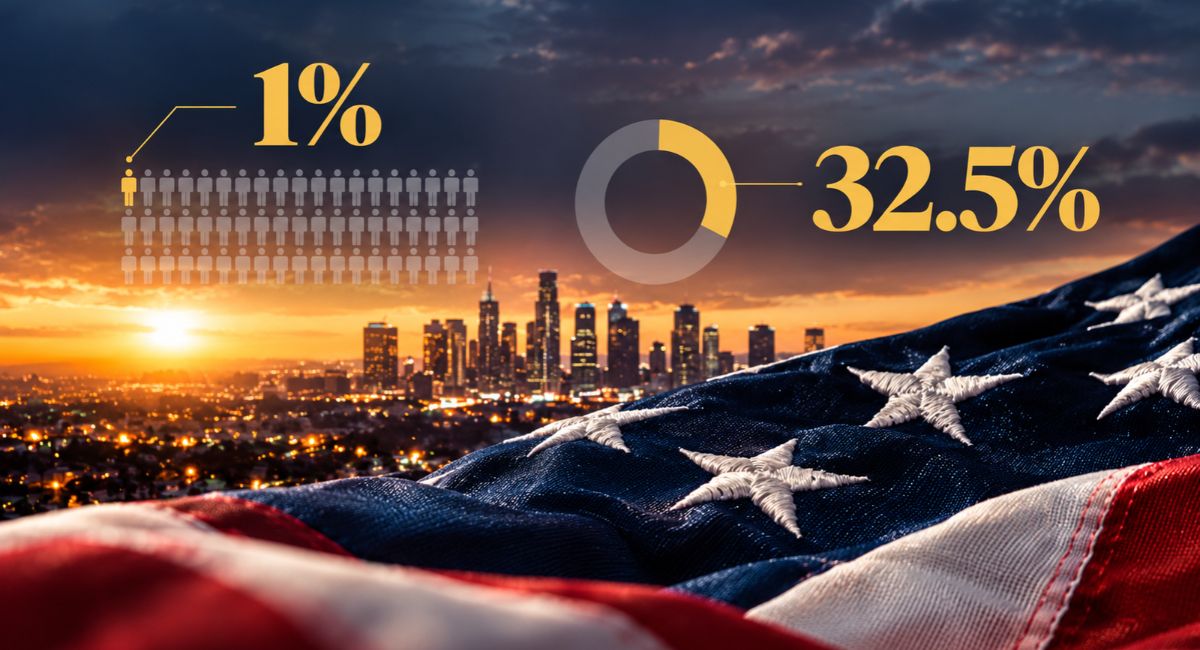
America’s wealthiest 1% of households now own nearly one-third of the country’s entire household wealth.
The latest Federal Reserve figures put their share at 32.5% in the second quarter of 2026, the highest recorded since the Fed’s quarterly series began in 1989.
In dollar terms, that’s approximately $60.3 trillion. The bottom half of American households collectively own about $4.3 trillion, representing just 2.3% of total household wealth.
Think about that for a moment. One percent of households controls roughly 14 times as much wealth as the entire bottom half combined.
We’ve followed wealth statistics long enough to know that enormous numbers can lose their meaning. Sixty trillion dollars is almost impossible to visualize. The distribution of that money is much easier to understand.
These figures expose a serious weakness in America’s economic model: we’ve built an extraordinary machine for growing wealth, and the people who already own the most capital are collecting an increasingly large share of its output.
America has become extraordinarily good at creating wealth. But who actually gets to own it?
The Richest 1% Just Set Another Record
According to the Federal Reserve’s Distributional Financial Accounts, the richest 1% controlled 31.7% of household net worth in the first quarter of 2026.

Three months later, their share reached 32.5%. The longer-term comparison is particularly revealing. In 1989, the top 1% held approximately 22.8% of household wealth. Their share has since increased by almost ten percentage points.
Here’s how American wealth was distributed in June 2026:
Next 9%
Middle 40%
Bottom 50%
The richest 10% therefore hold 68.9% of the country’s household wealth.
Even within the top 1%, wealth is remarkably concentrated. The richest 0.1% alone controls approximately 15% of total household net worth.
These are wealth estimates covering assets such as stocks, real estate, retirement accounts, and businesses, minus outstanding debts.
They reveal who owns the accumulated economic resources of the country. That’s an important measure of financial power.
The Top 1% Added $5.5 Trillion in Three Months
The Federal Reserve’s wealth estimates show that the richest 1% held $54.83 trillion at the end of March 2026.
By the end of June, that figure had climbed to $60.31 trillion. That’s an increase of approximately $5.48 trillion in one quarter.
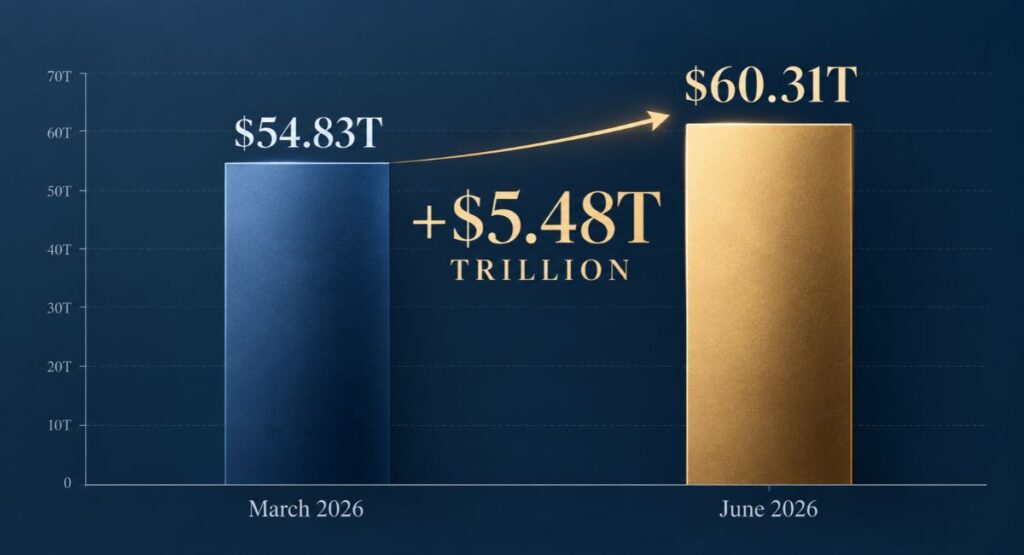
For perspective, the entire bottom half of American households held approximately $4.28 trillion in net worth at the end of that same quarter. The top 1%’s estimated wealth increased by more in three months than the bottom half collectively owned.
In one quarter, the top 1%’s estimated wealth increased by more than the total net worth held by the bottom half of Americans.
Much of this kind of wealth growth occurs through changes in asset prices. Rising stock valuations and business ownership stakes can increase fortunes by billions without their owners selling a single share.
The figures are also subject to revisions. Still, the scale is staggering. A system capable of generating that much additional wealth for its richest participants should be capable of building considerably more financial security for ordinary households.
Stock Ownership Explains Much of the Divide
The connection between stock ownership and wealth concentration is especially important.

In an earlier Counted Wealth article, we examined how the top 1% owns half of America’s corporate-equity and mutual-fund wealth.
Federal Reserve figures for the second quarter of 2026 put that share at 50.9%. That ownership concentration creates enormous differences in the financial benefits of a rising market.
The share of US corporate-equity and mutual-fund wealth owned by the richest 1%.
This video illustrates how asset ownership and compound returns help explain the growing concentration of American household wealth.
View this post on Instagram
Consider a hypothetical 10% investment return:
- A household with $10,000 invested earns $1,000.
- A household with $250,000 invested earns $25,000.
- A household with $20 million invested earns $2 million.
Every investor receives the same percentage return. The dollar gains depend on how much capital they already own. Compounding makes that difference increasingly powerful over decades.
Investing is one of the most valuable opportunities available in the modern economy, and broader access to productive assets is a significant financial achievement.
However, there remains a considerable gap between having access to investment opportunities and accumulating enough capital for investment returns to meaningfully transform a family’s financial situation.
The stock market has become remarkably accessible. Meaningful ownership remains much harder to achieve.
Working Americans Face a Different Financial Reality
For millions of households, accumulating investments requires making difficult choices with money they need today.
Housing, food, transportation, insurance, and childcare consume substantial portions of their incomes. Building a meaningful portfolio becomes an uphill exercise.
We recently reported that one in five Fidelity 401(k) savers had an outstanding retirement-plan loan. That number deserves attention alongside the new wealth-concentration record.
Retirement accounts are helping millions accumulate assets. A sizable group of participants is simultaneously borrowing against those savings.
America’s retirement system increasingly expects individuals to become investors, even as their immediate financial obligations make consistent investing difficult.
We’ve become far too comfortable telling financially stretched households to solve structural wealth inequality through personal discipline. Budgeting matters. Saving matters. Financial habits matter enormously.
Personal financial discipline matters, but it cannot solve a national wealth-distribution problem on its own.
But when half the country collectively owns 2.3% of household wealth, another lecture about skipping expensive coffee is a ridiculous response.
The Billionaire Economy Has Its Own Momentum
At the very top, wealth creation is accelerating through business ownership, technology, and rising valuations.

Earlier this month, we wrote about how the Forbes 400 cutoff reached $4.4 billion. The 400 richest Americans were worth an estimated $8 trillion combined in 2026.
Artificial intelligence has helped produce extraordinarily valuable companies and enormous fortunes for founders and early investors.
We welcome the creation of successful businesses. Founders who build valuable companies deserve substantial financial rewards. We also believe the wider economy deserves a much larger ownership stake in its own progress.
Workers contribute to productivity. Consumers support businesses. Public investment helps produce the infrastructure, research, and institutions that enable private wealth creation.
An economy that concentrates an ever-growing share of its rewards in existing portfolios will eventually struggle to maintain public confidence.
America’s Wealth Rules Need Serious Reform
I would be wise to start with three changes.
First, make investing financially meaningful for lower-income households. Automatic retirement enrollment helps, although enrollment alone accomplishes little for someone who cannot afford contributions. Refundable government matching contributions, deposited directly into investment accounts, would give lower-income workers actual capital.
Second, confront housing scarcity. Local restrictions that prevent construction help protect existing property values and make entry more expensive for younger families. Housing policy has become an enormous wealth-distribution issue.
Third, reform the treatment of massive inherited fortunes. Under current IRS basis rules, inherited property generally receives a tax basis tied to its fair market value at death. That can eliminate income tax on appreciation accumulated during the previous owner’s lifetime.
Congress should reconsider this treatment for exceptionally large estates. Eight-figure inheritances deserve much closer scrutiny.
These reforms would require careful implementation. The current concentration of wealth is a far greater reason for concern than the administrative difficulty of changing policy.
The Number That Should Define the Debate
The Federal Reserve’s 32.5% figure is a record, and future market movements will change it.
Wealth concentration will fluctuate with asset prices, household debt, business valuations, and the economy.
The longer-term trajectory deserves the attention of anyone concerned about America’s financial future.
In this video, journalist Lisa Remillard examines Federal Reserve data showing how America’s wealthiest households have pulled further ahead of the rest of the population.
We want an America that produces enormous fortunes. We also want an America where millions more families build substantial fortunes of their own.
Our financial system has demonstrated an extraordinary ability to create wealth. The next great economic challenge is expanding meaningful ownership of that wealth.
And until we make progress, another record for the richest 1% should be treated as a warning about who is getting ahead.
This article is for general informational purposes and does not constitute personalized financial, investment, tax, or legal advice.