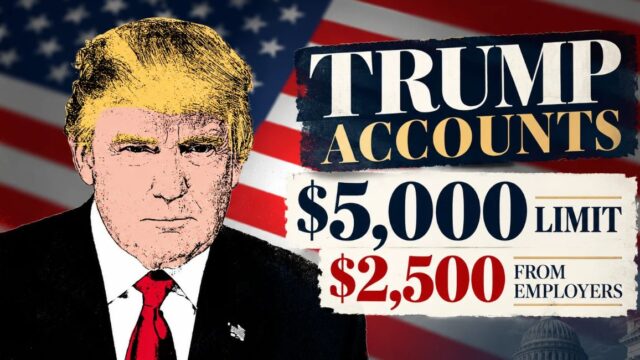


The federal government has just done something unusual: opened millions of investment accounts for children whose parents never asked for one.
No application. No initial paperwork from the family. No requirement that a parent had previously shown interest in the program.
On October 1, the Treasury Department announced that it had completed automatic enrollment for Trump Accounts, creating accounts for more than 60 million additional eligible children.
A week later, the White House reported that nearly 70 million Trump Accounts had been established altogether.
Those are enormous numbers. But there’s a distinction worth making before anyone starts imagining 70 million children receiving government checks.
Opening an account and putting money into it are two different things.
And that difference tells us quite a bit about what this program can realistically accomplish.
Key Takeaways
- Nearly 70 million accounts: Treasury’s automatic enrollment expanded access without requiring parents to apply first.
- The $1,000 isn’t automatic: Eligible children still need an authorized adult to complete the required steps.
- Over $4.5 billion reported: Federal, family, and philanthropic contributions are funding the program.
- Account access isn’t the same as wealth: The long-term impact depends on how much money actually reaches children.
Treasury Has Removed the First Obstacle
Originally, Trump Accounts required an adult to take action. Parents or guardians could submit an election, complete the account setup process, and begin preparing an investment account for their child.
That system depended on something government programs frequently struggle with: getting people to fill out forms.
Under the Treasury Department’s October 1 announcement, eligible children under 18 with valid Social Security numbers now have accounts established for them, even when their parents never applied.
The change is significant because it separates account creation from parental participation. Here’s how the system works now:
| Step | Automatic? |
|---|---|
| Treasury creates an eligible child’s account | Yes |
| Eligible government or nonprofit gifts can reach an unclaimed account | Yes |
| Parent claims and manages the account | No |
| Eligible child receives the $1,000 federal seed | Requires additional action |
Parents must still verify their identity, establish their relationship to the child, and accept the account terms before they can manage it.
That’s an important improvement, even if it doesn’t solve everything.
A financial benefit that requires complicated enrollment procedures will inevitably miss some of the people it was designed to help.
Removing that initial obstacle makes sense.
WFYI News 4 explains how automatic enrollment works and what parents need to do to claim their child’s Trump Account.
Why Treasury Changed the Rules
The explanation becomes clearer when you read the temporary federal regulations published September 30.

Treasury and the IRS considered the possibility that children could miss investment contributions simply because no adult completed an account application.
That creates a particularly strange problem when the contributions come from governments or philanthropic organizations rather than parents.
Imagine a foundation offering $250 to every qualifying child in a particular community.
Should a child lose that money because their parents never registered for an investment account? Treasury’s answer is effectively no.
The new arrangement allows automatically established accounts to receive qualifying government and nonprofit contributions without waiting for parents to claim them.
The money can be invested through a pooled investment structure while individual account ownership and records are maintained. From an administrative perspective, that’s clever.
Instead of asking millions of families to participate before a donor can reach their children, Treasury creates the infrastructure first.
The opportunity no longer disappears merely because someone missed a form.
The $1,000 Is Not Automatic
This is where the headline numbers can become misleading. The original Trump Account proposal attracted attention because eligible children born between January 1, 2025, and December 31, 2028, can receive a one-time $1,000 federal contribution.
That benefit still exists. But automatic enrollment doesn’t mean every child receives it.
The federal seed is limited to children meeting additional eligibility requirements, including U.S. citizenship and the qualifying birth years. An authorized adult must also make the appropriate election and claim the account.
The IRS instructions explain the separate election for the federal contribution. Consider two children. One is 14 years old. Treasury may have created an account for that child, but the child doesn’t qualify for the $1,000 federal seed because of their birth year.
The other was born in 2026. That child may qualify for the deposit, but an adult still needs to complete the required steps.
Both can have accounts. Their starting balances may look entirely different. That’s why you shouldn’t confuse enrollment statistics with money actually invested.
CNBC examines whether Trump Accounts make financial sense for families and what parents should consider before participating.
Nearly 70 Million Accounts. How Much Money?
The administration’s October 7 figures provide a more useful financial picture.
Reported Trump Account funding since the July 4 launch:
| Funding source | Amount |
|---|---|
| Federal $1,000 contributions | $1.3 billion |
| Family and friends | Over $600 million |
| Philanthropic gifts | $2.6 billion |
| Total | Over $4.5 billion |
Those numbers are genuinely substantial. Still, 70 million accounts and $4.5 billion invested don’t mean that every account has a meaningful balance. Some accounts are newly created, unclaimed, or unfunded.
The most interesting part is the $2.6 billion in philanthropic money. It’s larger than the reported federal seed contributions.
That suggests the long-term financial influence of Trump Accounts could depend heavily on whether corporations, foundations, and wealthy donors continue participating.
The government may have built the account infrastructure, but private funding could become a major driver of the balances inside it.
More Investors Doesn’t Automatically Mean Less Inequality
There’s a tempting argument that giving every child an investment account will eventually reduce America’s wealth gap.
The appeal is understandable. Starting early is enormously valuable in investing, particularly when compounding has decades to work.

We explored that arithmetic in our previous look at the math. But access to an account and the ability to build a substantial portfolio aren’t the same thing.
A wealthy family might contribute thousands of dollars every year. A family struggling with rent, groceries, and childcare might contribute nothing.
Both children could technically participate in the stock market. Their eventual balances could be dramatically different.
This resembles the problem we discussed in our article about the stock ownership gap. America already has broad stock market participation. Yet ownership of stock market wealth remains highly concentrated.
Trump Accounts can potentially bring more young Americans into investing.
Whether they substantially narrow the wealth gap depends on how much money reaches children who otherwise would have little invested. That’s a different challenge from creating accounts.
There’s Also the Question of Control
Another aspect deserves attention. Treasury has established financial accounts without first receiving applications from millions of parents.
The regulations describe safeguards intended to protect sensitive information, including verification before an adult can claim an account.
That’s reassuring, but the government should be exceptionally transparent about account administration, data protection, and how unclaimed assets are handled.
Parents also need to understand what investments their children may receive.
The ordinary investment framework emphasizes diversified, low-cost U.S. equity index funds. However, the new regulations also allow certain qualifying donations of individual corporate stocks, subject to holding restrictions.
Those investments can introduce additional concentration risk. A gifted stock might perform wonderfully. It might also lose substantial value. Free investments aren’t necessarily risk-free investments.
What Parents Should Actually Do
For parents discovering that their child now has an account, focus on a few practical steps:

- Check eligibility. Having an account doesn’t necessarily mean the child qualifies for the $1,000 federal contribution.
- Use official channels. Visit TrumpAccounts.gov or the official app to review the claiming process.
- Understand contribution limits. Family and employer contributions generally share a $5,000 annual contribution limit during the growth period, with special treatment for certain other contributions.
- Review the investment and tax rules. These are tax-advantaged accounts, not simply tax-free savings accounts.
FIRE Psy Chat explains how parents can claim an automatically opened Trump Account, check eligibility for the $1,000 contribution, and understand the investment rules.
And if parents plan to build a meaningful balance over time, the bigger question is how regular contributions fit into their household finances.
A long investment horizon is an advantage. But it doesn’t eliminate the need to make sensible decisions along the way.
The Accounts Are a Beginning, Not the Outcome
The underlying idea of giving children access to invested capital before they’re old enough to understand investing has considerable merit.
There is something economically sensible about allowing time to do work that most adults wish they had started earlier.
Automatic enrollment is a better approach than expecting every household to navigate a new financial program.
But calling 70 million accounts a wealth-building success is not accurate just yet.
The key questions are how many accounts are funded, what their balances look like, how contributions vary by family income, and whether children starting with very little are actually making financial progress. Those numbers will tell us more than the enrollment total.
Money can compound for decades. So can financial advantages between generations, which is one reason we’ve written about wealth across generations.
Treasury has accomplished something significant by creating investment accounts on such a large scale.
Now comes the harder part: ensuring those accounts contain enough money to make a difference.
Seventy million accounts is an impressive starting point. Seventy million meaningful investments would be a much bigger achievement.
This article is for general information and is not personalized investment, legal, tax, or financial advice.